

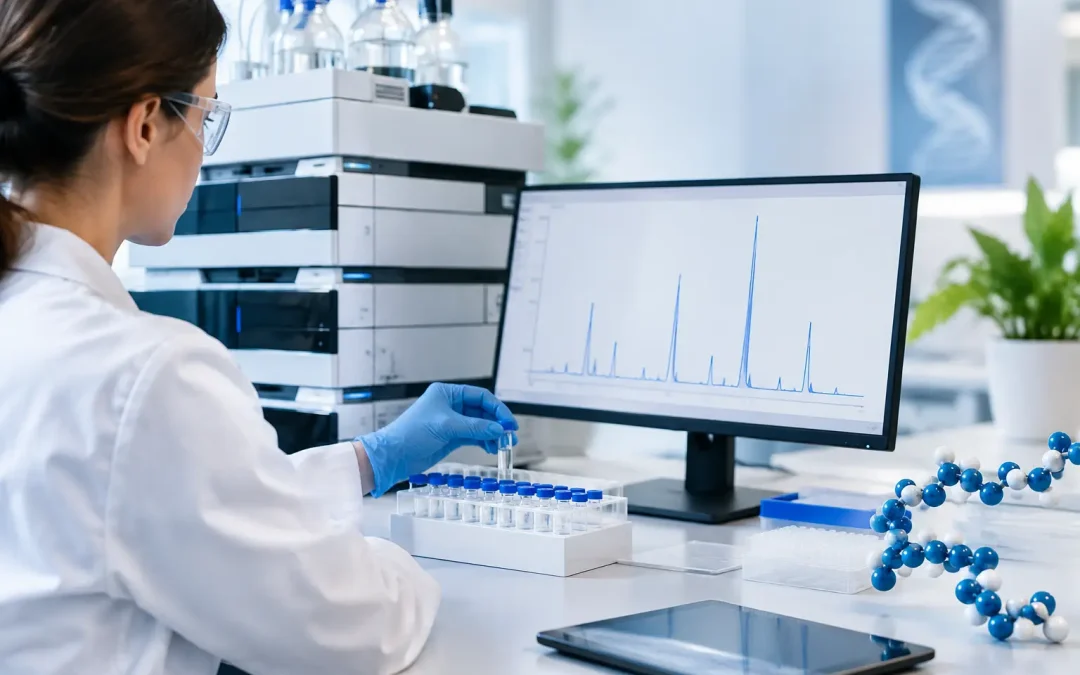
A purity figure without analytical context is only a partial answer. Peptide HPLC testing gives research buyers a practical way to evaluate the chemical profile behind a reported purity claim, but the value lies in more than a single percentage. A credible result connects a specific batch to a chromatogram, a defined method, and supporting documentation that allows the laboratory to make an informed sourcing decision.
For research-grade peptide materials, this distinction matters. Minor sequence-related impurities, residual synthesis byproducts, degradation products, and handling-related changes can all affect analytical consistency. High-performance liquid chromatography is one of the central tools used to characterize purity, yet it should be read as part of a quality system rather than as a standalone seal of approval.
What Peptide HPLC Testing Measures
HPLC separates chemical components in a sample as they move through a chromatographic column. Each component interacts differently with the stationary phase and mobile phase, causing it to elute at a distinct retention time. The detector records those eluting components as peaks on a chromatogram.
In a common reversed-phase HPLC method for peptides, the primary peak generally represents the target material. The area of that peak, expressed as a proportion of the total integrated peak area, is often reported as chromatographic purity. If the target peak accounts for 99% of the integrated area under the stated test conditions, the reported HPLC purity is 99%.
That result is meaningful, but it is not a universal measurement of every aspect of the vial’s contents. HPLC area percentage depends on the method, detector wavelength, integration parameters, and whether different compounds produce comparable detector responses. It is best understood as an analytical measure of relative purity under defined conditions.
Why the Chromatogram Matters
A chromatogram shows the evidence behind the number. A clean dominant peak with minimal secondary peaks supports the reported purity claim more clearly than a percentage listed without an accompanying trace or method reference.
Researchers should look for a defined retention time, an identifiable primary peak, and sensible peak integration. Small peaks are not automatically disqualifying. Their significance depends on their location, relative area, known impurity profile, and the requirements of the intended analytical workflow. A trace impurity at 0.2% may be immaterial in one assay and unacceptable in another highly sensitive application.
The more useful question is not simply, “Is the purity high?” It is, “Does this chromatographic profile meet the specifications and risk tolerance of this research program?”
How to Read an HPLC Result on a COA
A certificate of analysis should tie testing to the exact lot or batch being supplied. Batch traceability is fundamental: a generic sample chromatogram, marketing claim, or unassigned report cannot establish the analytical status of the material in hand.
Start by confirming that the batch identifier on the COA matches the product label and acquisition record. Then review the reported analyte name, test date, result, specification, and test method. A well-prepared document also identifies the laboratory or testing organization and includes appropriate authorization or quality review information.
For the HPLC section itself, assess whether the report provides enough detail to interpret the result. Useful information commonly includes the chromatographic mode, column, mobile phases, gradient, flow rate, detection wavelength, injection conditions, and retention time. Not every research buyer needs to reproduce the method internally, but sufficient method clarity indicates that the result is tied to a controlled procedure rather than a generic purity assertion.
The reported specification deserves attention as well. A result of 99.1% has different meaning when the release specification is not stated. A defined acceptance criterion clarifies whether the batch was assessed against a pre-established quality threshold. For buyers seeking high-purity research materials, a stated specification of 99% or greater creates a clearer benchmark than an isolated result alone.
What HPLC Cannot Confirm by Itself
HPLC is highly useful for purity profiling, but it does not independently establish peptide identity with complete certainty. A dominant peak at an expected retention time is supportive evidence, not a full structural confirmation. Peptides with related structures can sometimes elute closely or co-elute under a given method.
Mass spectrometry is commonly used alongside HPLC to support molecular identity by confirming expected mass. Depending on the peptide and research requirements, additional testing may address peptide content, amino acid composition, water content, residual solvents, microbial limits, endotoxin, or counterion composition. The appropriate panel depends on the material format and the intended research workflow.
This is where analytical discipline prevents overinterpretation. A 99% HPLC purity result does not necessarily mean 99% peptide content by weight. Water, salts, residual trifluoroacetate or acetate, and other non-chromophoric components may not be represented in the same way as peptide-related peaks. For quantitative preparation, researchers may require separate content or assay data rather than relying solely on area-percent purity.
Method Fit Determines the Value of the Result
There is no single HPLC method that is equally revealing for every peptide. Peptide length, hydrophobicity, charge, aggregation tendency, oxidation sensitivity, and sequence complexity influence separation behavior. A method that gives an excellent profile for one analyte may not adequately resolve a closely related impurity in another.
Detection settings also matter. UV detection at 214 or 220 nm is common for peptide bond absorption, while 280 nm can be informative for peptides containing aromatic residues. Different wavelengths may change the apparent response of impurities. Integration settings can also materially affect reported area percentages, particularly when low-level peaks sit near the baseline or the main peak shows tailing.
For this reason, analytical buyers should favor suppliers that treat HPLC as a controlled release test within a broader documentation framework. Independent third-party batch testing, transparent COA access, and consistent manufacturing controls provide more confidence than a purity claim presented without context.
Stability Is Part of the Analytical Picture
A passing release chromatogram reflects the tested batch at the time of analysis. It does not eliminate the need for appropriate storage, handling, and research-use controls after receipt. Some peptides can be susceptible to oxidation, hydrolysis, deamidation, aggregation, or adsorption depending on sequence and environment.
When a laboratory observes an unexpected result, it should avoid assuming the original release test was incorrect. Review the chain of custody, storage history, reconstitution conditions, solution age, freeze-thaw exposure, and analytical method before drawing conclusions. Retained samples and documented handling procedures are especially valuable when investigating a material change.
A Practical Standard for Research Sourcing
A defensible peptide sourcing process connects the purchasing record, vial label, batch-specific COA, and internal receipt controls. HPLC data should be checked before material enters a sensitive workflow, not after an unexplained result consumes time and samples.
For laboratories working with high-standard research materials, the strongest documentation package typically combines a batch-specific HPLC purity result with identity support, clear specifications, and traceable production and testing records. GMP-compliant manufacturing practices and U.S.-based quality operations can further strengthen consistency expectations, although they do not replace direct review of the batch documentation.
Neurovia Peptides centers its research-grade sourcing approach on independently tested batches, accessible COAs, and defined quality standards. Those controls are designed for laboratory, analytical, and scientific research use only. They are not medical claims, and research compounds should not be represented or used as therapeutic products.
When to Request More Than a Purity Percentage
Additional documentation is warranted when the research method is especially sensitive to low-level contaminants, when the peptide will be used as an analytical reference, or when the observed molecular behavior must be tightly controlled. It may also be necessary when comparing lots, transferring a method between laboratories, or investigating inconsistent experimental data.
In these cases, ask for the batch-specific chromatogram, relevant method conditions, identity data, and any available information on counterion, water content, or peptide content. The goal is not paperwork for its own sake. It is to ensure the material specification aligns with the analytical question being asked.
A well-documented HPLC result gives researchers a starting point for confidence, not a reason to stop asking questions. The right batch is the one whose testing record is clear enough to support the precision your work demands.